HPC-AI Advisory Council UK 2026, the national compute
- Summary: a map of the talks, the highlights and the people
- The national compute: the new structure, its systems and its funding
- Day 1, 13 October
- Day 2, 14 October
- UK HPC systems
AI tools, Claude and ChatGPT, helped me digest the material: unpacking a talk’s slides, explaining a term I didn’t know, and researching the systems. I’ve checked what they said against the sources linked.
Unpacking the new public compute infrastructure
The keynote presented a new structure on public compute infrastructure. Here’s a digestion on that.
Before: the tiers, sorted by size
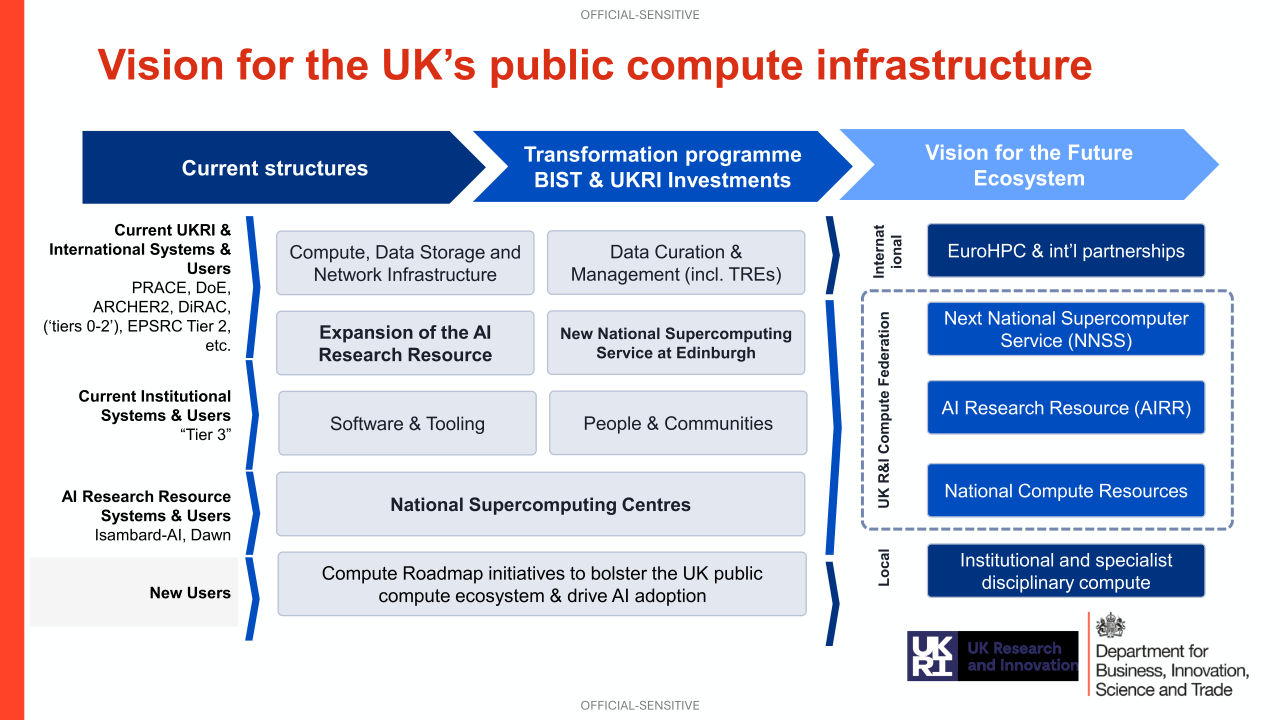
The keynote’s “Vision for the UK’s public compute infrastructure” slide (p. 5) lumps “PRACE, DoE, ARCHER2, DiRAC, EPSRC Tier 2” together under current structures as “tiers 0–2”, with institutional systems as “Tier 3”, and AIRR’s Isambard-AI and Dawn in a row of their own.
The usual meaning of each tier is:
| Tier | What it is | Examples |
|---|---|---|
| 0 | International, beyond one country | PRACE (now EuroHPC), and DoE’s machines in the US |
| 1 | National services | ARCHER2 (EPSRC/NERC) and DiRAC (STFC) |
| 2 | Regional or specialist systems, funded by EPSRC and hosted by a university or a consortium | Isambard 3, Baskerville, Cirrus, CSD3, JADE, Kelvin2… |
| 3 | A university’s own cluster | QMUL’s Apocrita, Exeter’s own |
In this model, each research council funded and allocated its own systems, and the Compute Roadmap calls the result “fragmented and uncoordinated”. Tier 2 was a series of fixed-term EPSRC grants. That is why Isambard 3’s grant ends in March 2027 for example.
After: three national services, sorted by purpose
The keynote’s next slide, “Where to go” (p. 6), puts three services under a “UK R&I Compute Federation”:
- NNSS: “mission driven modelling and simulation workflows at the largest scale”. This is the successor of tier 1’s ARCHER2.
- AIRR: AI workflows, with “strategically managed access driven by Government priorities”. AIRR started in 2023 (Isambard-AI and Dawn) and was never part of the tiers.
- NCRs: “accessible for all workflows at a smaller scale”, on a range of hardware. The NCR slide (p. 26) calls them “an evolution of support for ‘tier 2’”. UKRI funds the infrastructure, and the platform and access layers are built together with the sites. The NCRs come in a “rolling programme of phased investment” rather than as one-off grants to each centre.
What stays the same:
- EuroHPC is still the international layer.
- A university’s own cluster is still there, as “institutional and specialist disciplinary compute”, the local layer on the right of p. 5.
What’s new around the three services:
- Users apply through one portal, the “single pane of glass”, for the NCRs, AIRR and the NNSS.
- Community Centres of Excellence (CCEs) give user support for each research domain, separate from the systems themselves.
How the old systems move
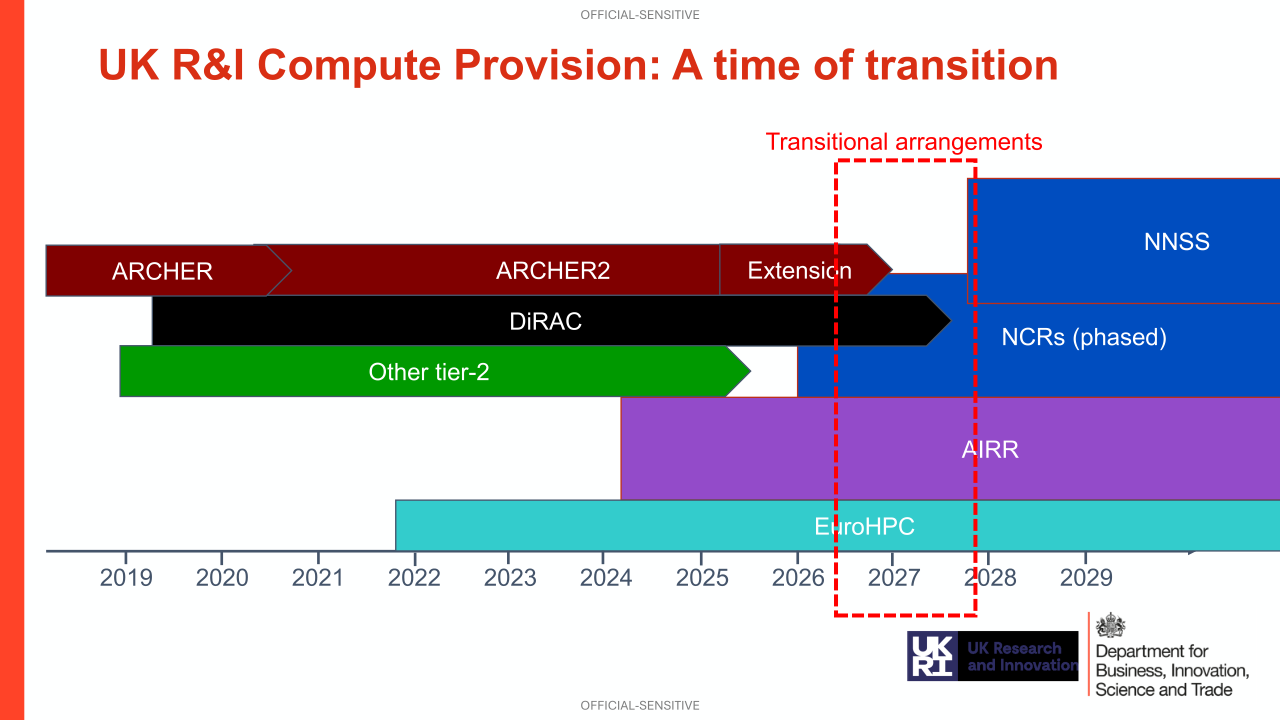
The transition slide (p. 15) shows:
- ARCHER2 → NNSS. In between, the NCRs on CPU (Cirrus, and Charger from the end of 2026) fill the gap after ARCHER2 ends in November 2026 and before the NNSS goes live in Q4 2027.
- DiRAC → the NNSS and the NCRs over 2026–2028, as the talk put it. DiRAC stops being a separate tier 1 service.
- “Other tier-2” → NCRs, phased. Some of the tier-2 systems become NCRs: Isambard 3, Cirrus, and Baskerville as a new system. The slide ends the “other tier-2” bar in 2025, and the phase 1 list names no others.
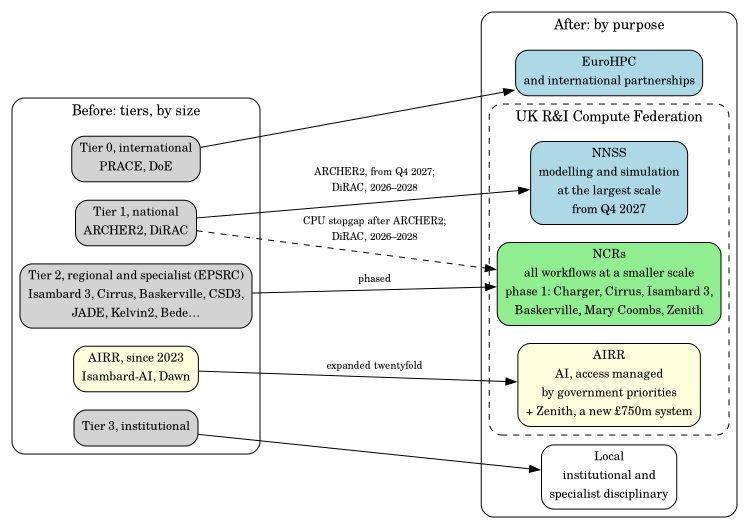
So the main change is that tier 1 and tier 2 stop being levels of size. Systems are grouped by what they are for instead: the largest simulations (NNSS), AI (AIRR), and everything else on a mix of hardware (NCRs). That is also why the NCRs are both a stopgap for ARCHER2 and meant to stay.
A map to national HPC systems
The HPC systems in the UK that came up over the two days, and the national services they are part of, are on UK HPC systems, with where each came up. It is a page I’ll keep adding systems to.
Three more came up from outside the UK and Europe:
- El Capitan
- At Lawrence Livermore, #1 on the TOP500 from November 2024 until June 2026, when it became #2, and a Starfish customer (Starfish).
- Fugaku and FugakuNEXT
- RIKEN’s Arm supercomputer on Fujitsu’s A64FX, #1 on the TOP500 from June 2020 to November 2021, and its successor, aiming at 100× its application performance with the MONAKA-X CPU (Fsas Technologies).
- Eos
- NVIDIA’s own supercomputer, 4,608 H100, which QMatter ran on alongside a quantum computer at LRZ (the venture scientist).
The instability of funding
A sysadmin from EPCC I met at the conference (meeting other people) and I discussed the instability around funding and maintaining HPC in the UK, including for the dRTPs (digital research technical professionals, UKRI’s umbrella term for the people working in this space). I said HPC in the UK feels unstable to me, without a guaranteed future: it often works by writing the next proposal, and planning on the assumption that it gets a green light.
He said that is exactly what happened to them. In 2023, under Rishi Sunak, Edinburgh was chosen to host the UK’s exascale supercomputer, about £800m. Keir Starmer’s government cut it in August 2024, a month after taking office, and brought it back in June 2025 at up to £750m, no longer called exascale. ARCHER2 is in room 3 of EPCC’s Advanced Computing Facility, and in anticipation of the new supercomputer, which room 3’s floor space and power could not take, they built room 4, a new £31m wing. During the uncertain period, from the cut until the system came back, all that work felt wasted.
We compared the UK situation with the US from time to time, as I had some experience there in the past. I don’t fully understand the big picture, but it seems the national lab model in the US, and its funding (e.g. through the DoE), are much more stable, so HPC facilities and their people can thrive there. And because of that stability, they can plan for the long term and collaborate: they are not in competition, at least not as cut-throat, and not as much in fire-fighting mode, so they can invest in the future. Notable technologies from there are ZFS on Linux and Spack from LLNL, and Shifter and Podman-HPC from NERSC. He also observed that the stack in the UK seems less of a joint effort reused across HPC centres, e.g. EPCC’s SAFE and Bristol’s AIRRPortal.
Let’s hope that the new structure provides a more stable foundation, both for planning the hardware and for the dRTPs, so that we can invest more in the future and collaborate more.