HPC-AI Advisory Council UK 2026, day 2
Live notes
Live notes from the HPC-AI Advisory Council 8th Annual UK Conference, Mattioli Woods Welford Road Stadium, Leicester, 13–14 October 2026. Updated through the day; day 1 is here.
09:00 Opening
Day 2 Opening — Brian Sparks (HPCAIC), Mark Wilkinson (DiRAC)
09:05 Keynote: public compute infrastructure
Day 2 Keynote: Building Public Compute Infrastructure for the Future of Research — Kay Yeung (UKRI), Christina Kerr (DBIST)
- AIRR
- EuroHPC
UKRI’s vision for the NNSS (Next National Supercomputing Service), from the slide:
- NNSS will target mission-driven research and support strategic national goals, with a focus on delivering impact.
- There will be several access routes, including through Grand Challenges (this can take different forms).
- A Grand Challenge is a large-scale problem or opportunity in a priority area of national or strategic importance that is ambitious and difficult to address and will lead to concrete outcomes. Addressing the challenge can advance knowledge, improve lives and/or drive growth.
- Areas of national and strategic importance include the UK’s Industrial Strategy (IS8) sectors but are not bounded by it.
NCR Phase 1 acts as a stopgap between ARCHER2 and the NNSS, but it is also intended to be permanent, complementary infrastructure.
Communities Centres of Excellence (CCEs), from the slide:
What are CCEs and what are they aiming to achieve?
CCEs will provide a world class service layer and professional support for researchers and innovators to utilise the NCRs. They will provide user-centred support, resources, expertise and community coordination to enable users to maximise the use and value of the NCRs, and for the NCRs to deliver maximum research, societal and economic impact.
There are three core functions to a CCE:
- Stewardship of NCR user communities
- Services to support NCR users: e.g., DevOps, RSEs, training opportunities, support code deployment, updating, porting etc.
- Resource provision, facilitating access and allocation of compute capacity to maximise the benefit and utilisation of the NCR portfolio
The balance between the three functions will reflect the needs of the communities being served and therefore may differ from one CCE to another.
Someone in the audience asked about bringing EESSI from EuroHPC to the UK. EESSI combines several technologies:
| Layer | Technology | Purpose |
|---|---|---|
| Software | EasyBuild | Builds optimised scientific applications |
| Modules | Lmod | Allows users to load software |
| Compatibility | Gentoo Prefix | Provides a consistent runtime across Linux distributions |
| Distribution | CVMFS | Globally distributes software using caching |
| Architecture | archspec | Selects appropriate binaries for the CPU |
Mark: how are the Grand Challenges decided?
A: Defined by UKRI, after consultation.
The UK-LLM speaker: even internationally, there’s no infrastructure to train frontier AI (see the 40 million GPUh from his talk). Is building an even larger HPC on the government roadmap, say once every 3–4 years?
Audience: the Grand Challenges seem to focus on those that have impact quickly, e.g. 100-day drug discovery. How about foundational research, which has no direct immediate use?
A: 10–20 years down the line, there’s a balance of things we want to focus on.
10:05 UK HPC programme and sovereign AI
UK HPC Programme and Sovereign AI Opportunities — Pete Grindrod (Astut)
I would like us to invest in some things that are highly fundamental and are going to move much faster and much quicker. So my performance measure for this programme isn’t the number of GPU hours available. It isn’t a measure of the money spent. It’s a measure of the envy that the United Kingdom generates abroad. And companies, global companies that have a choice, will want to come and relocate here, with our facilities, our people, using our unique…
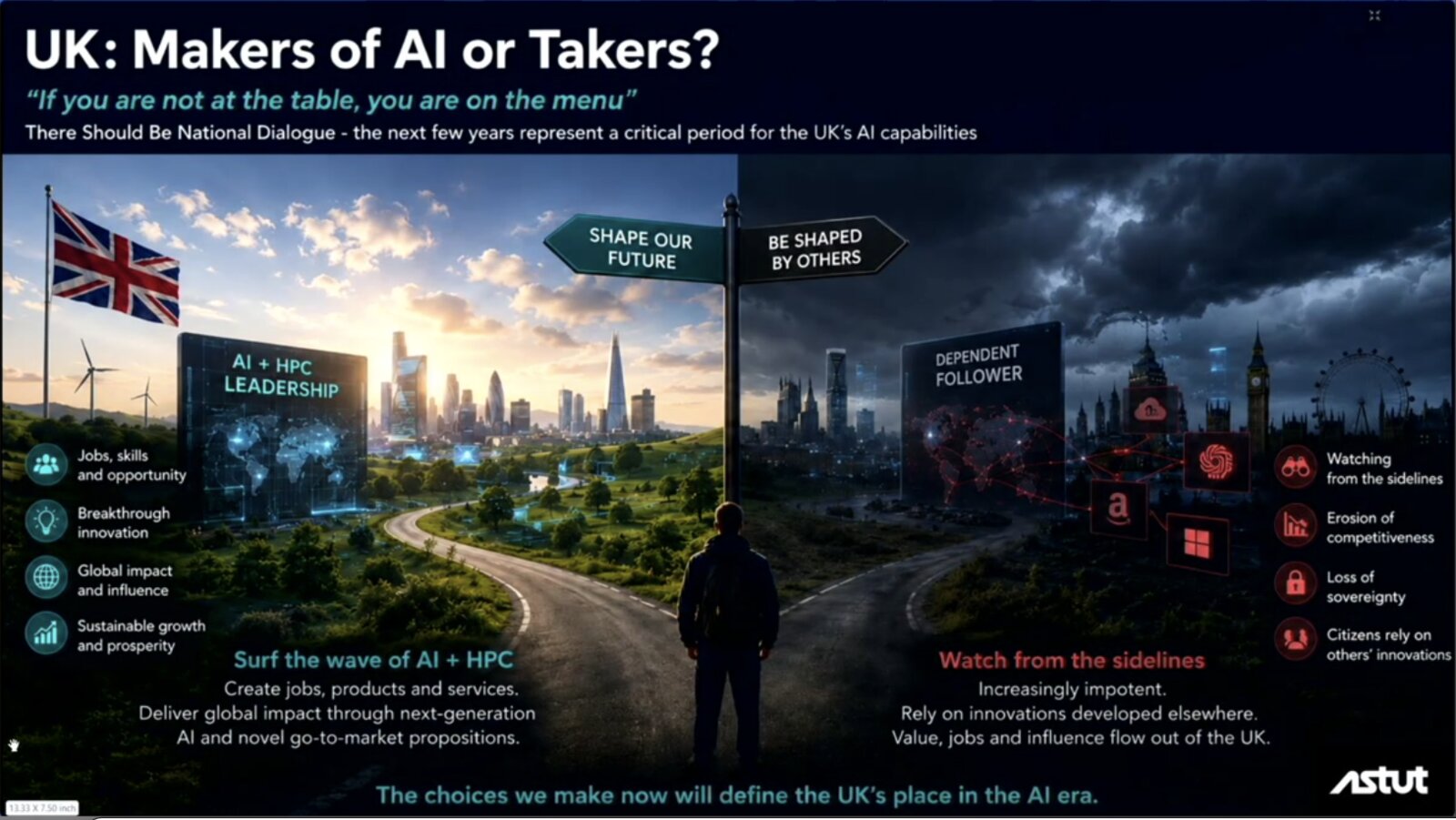
Curiosity-driven research: vulnerable, unallocated.
He is disappointed with the Alan Turing Institute, as one of its founders:
Because it didn’t do the last hard yards, which was to create new jobs, products and services in the United Kingdom. And now it’s under a reset, and if you listen to George Williamson, who’s the new CEO, I don’t know him very well, but I’m right behind him. He says, you know, this is an engine, and this is how we’re going to turn these wheels now…
a company like mine, or a bigger company, DeepMind, or OpenAI or Anthropic, actually, you know, they’ve got no idea where the technology is going to be in three years’ time. And Britain’s in danger, in danger, of becoming brilliant at regulation and hopeless at invention.
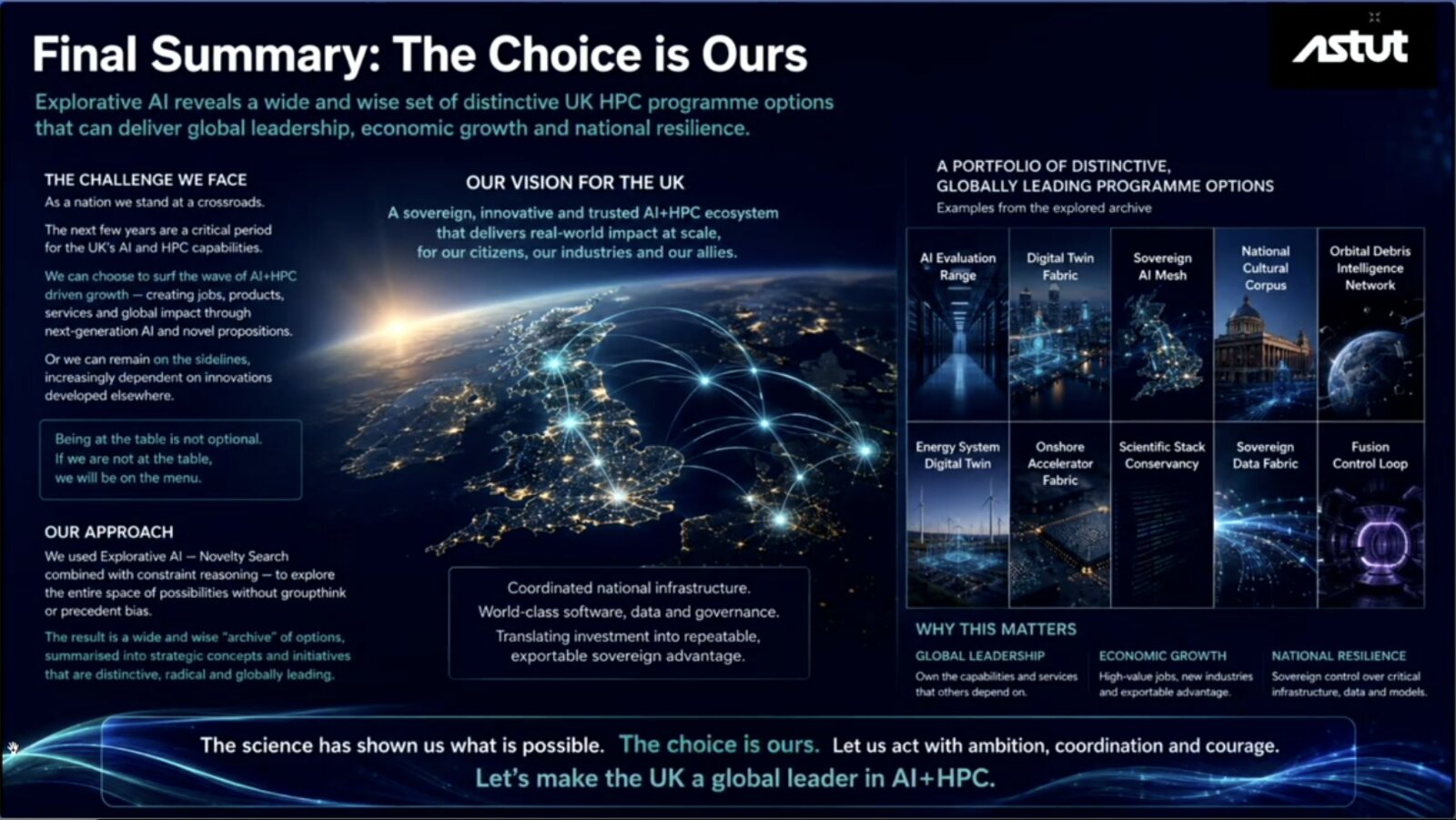
- Truth fallacy
- Reasoning fallacy
- Diversity fallacy
- Exploration fallacy
10:45 Coffee
11:10 Starfish (sponsor)
Starfish - Files Sorted: A Single Platform for Everything Related to File Storage Management — Jacob Farmer (StarFish Storage)
Customers include El Capitan, which held the top spot on the TOP500 until June 2026.
The storage cost increase last year: 10–20x, he said. The figure I could find is lower: VDURA’s Flash Volatility Index has SSD prices at 6.5x their level a year earlier, as of August 2026.
So a petabyte saved is a petabyte earned.
Chargeback/showback: capacity not used => 2 million.
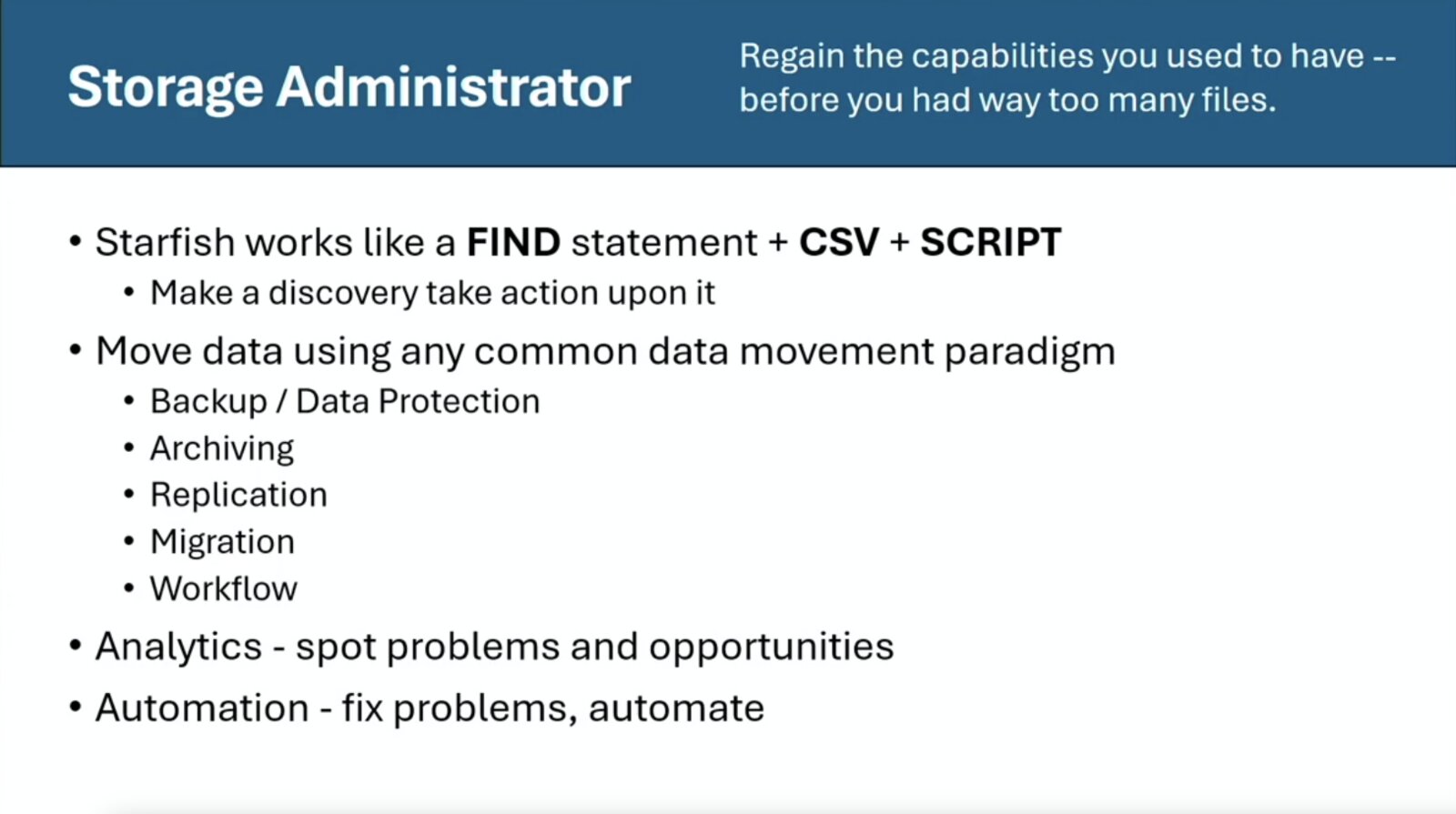
It runs 3 minutes behind the filesystem.
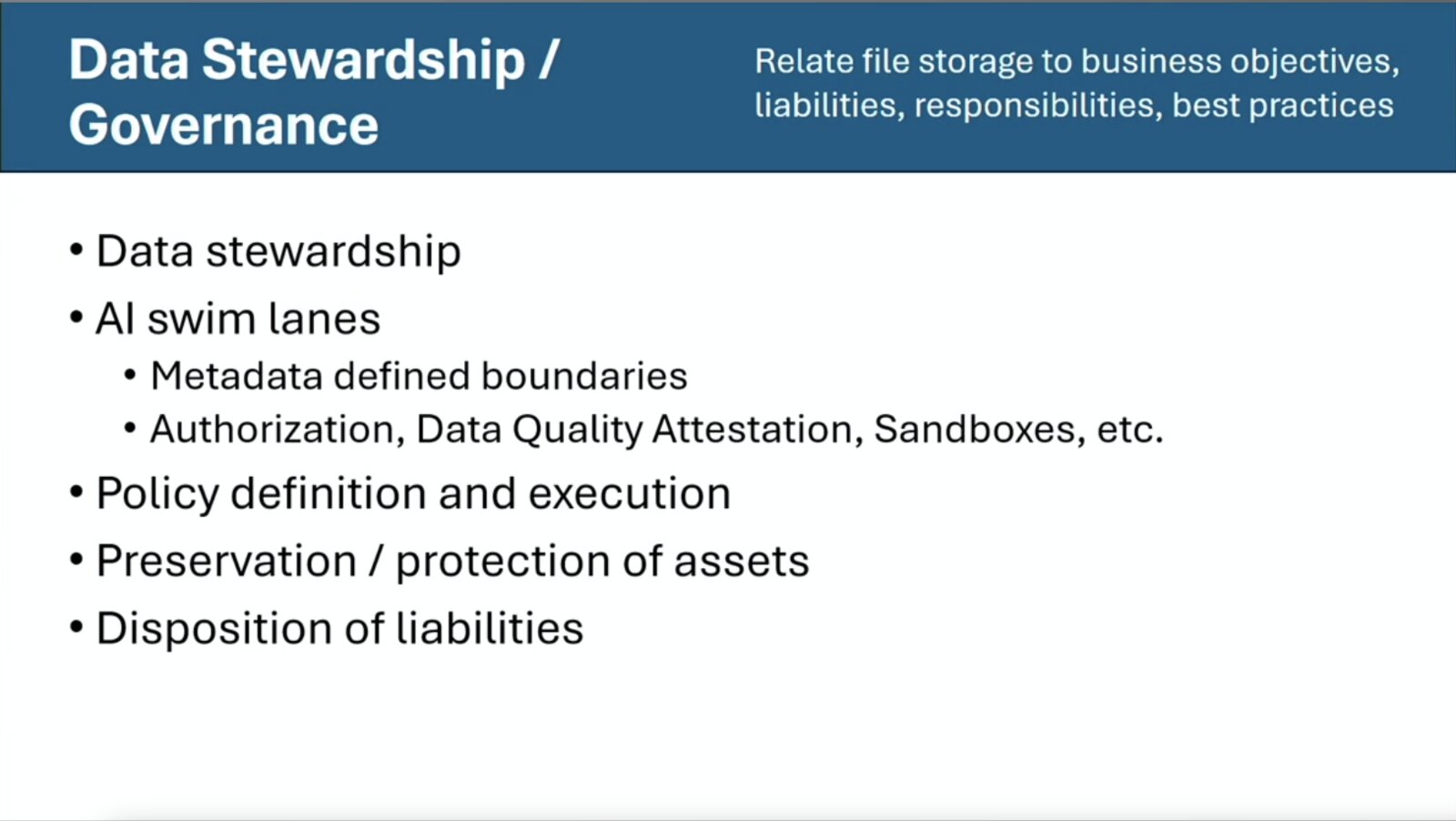
It seems to be something trendy in US universities to have data stewardship governance policies: mapped out with an LLM, enabling agentic workflows. E.g. serve files through S3 to agents, with only the subset of files you permit them.
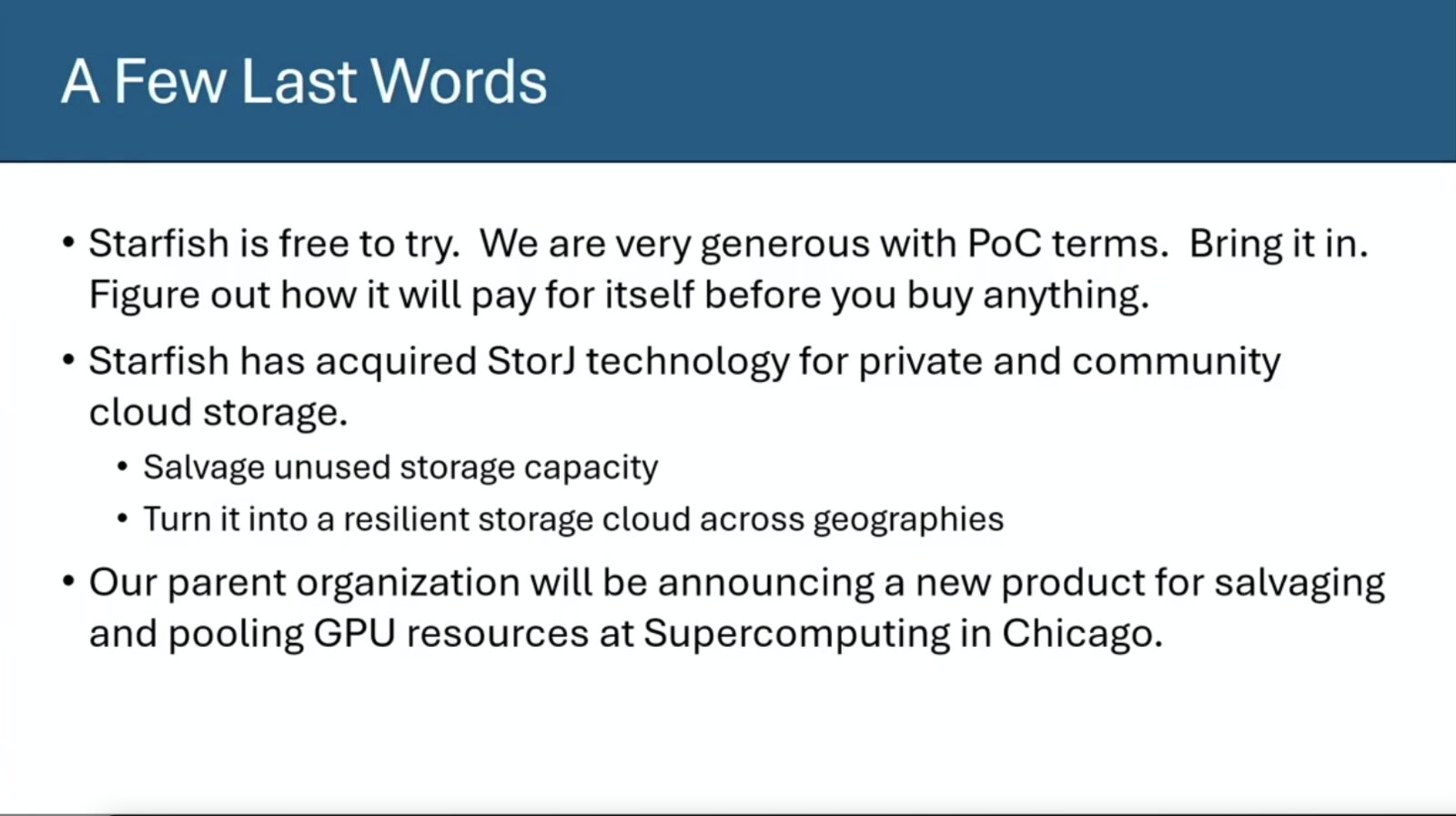
The pitch is that it pays for itself, with very generous terms for higher education and room for a PoC.
11:30 Lies We HPC People Tell Ourselves
Lies We HPC People Tell Ourselves — Andrew Jones (Microsoft)
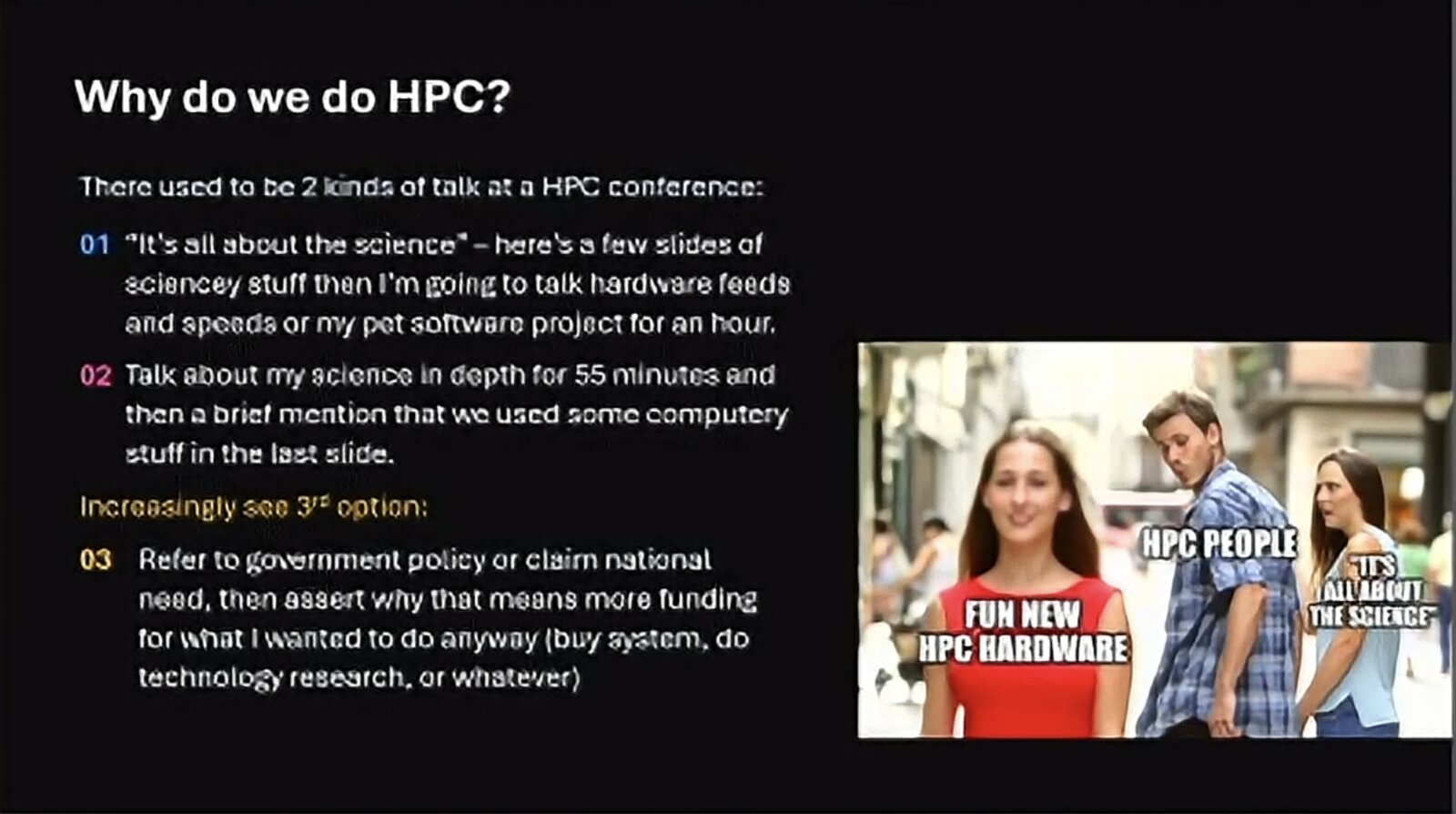
One of the lies is about not having enough HPC people, so we need to train the next generation. In reality, we aren’t paying them at the market rate.
A few comments from the audience:
- 15 years of experience, training 1,200 students, and only single digits (percent?) stay in HPC.
- The whole cohort except himself didn’t stay in HPC: they went to quant etc., not happy, but much better paid.
12:00 oxDNA-Kokkos in LAMMPS
oxDNA-Kokkos in LAMMPS: Delivering Performance-Portable, Multi-GPU Coarse-Grained DNA Modelling — Lewis Russell (Strathclyde)
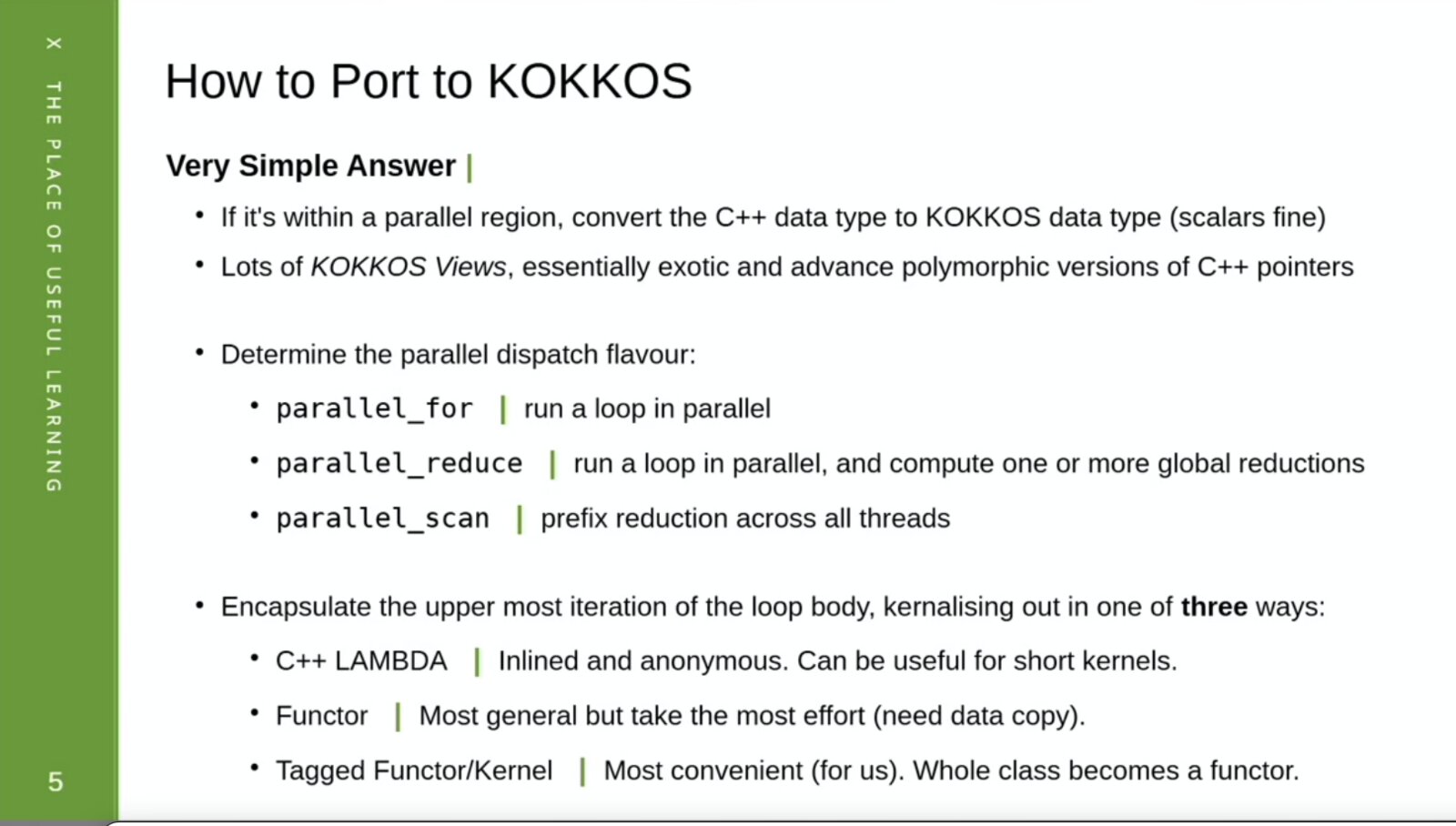
From the audience:
Q: Debugging in Kokkos?
A: AI helps. Multi-GPU: fences, atomics, etc.
12:30 DiRAC Training Academy
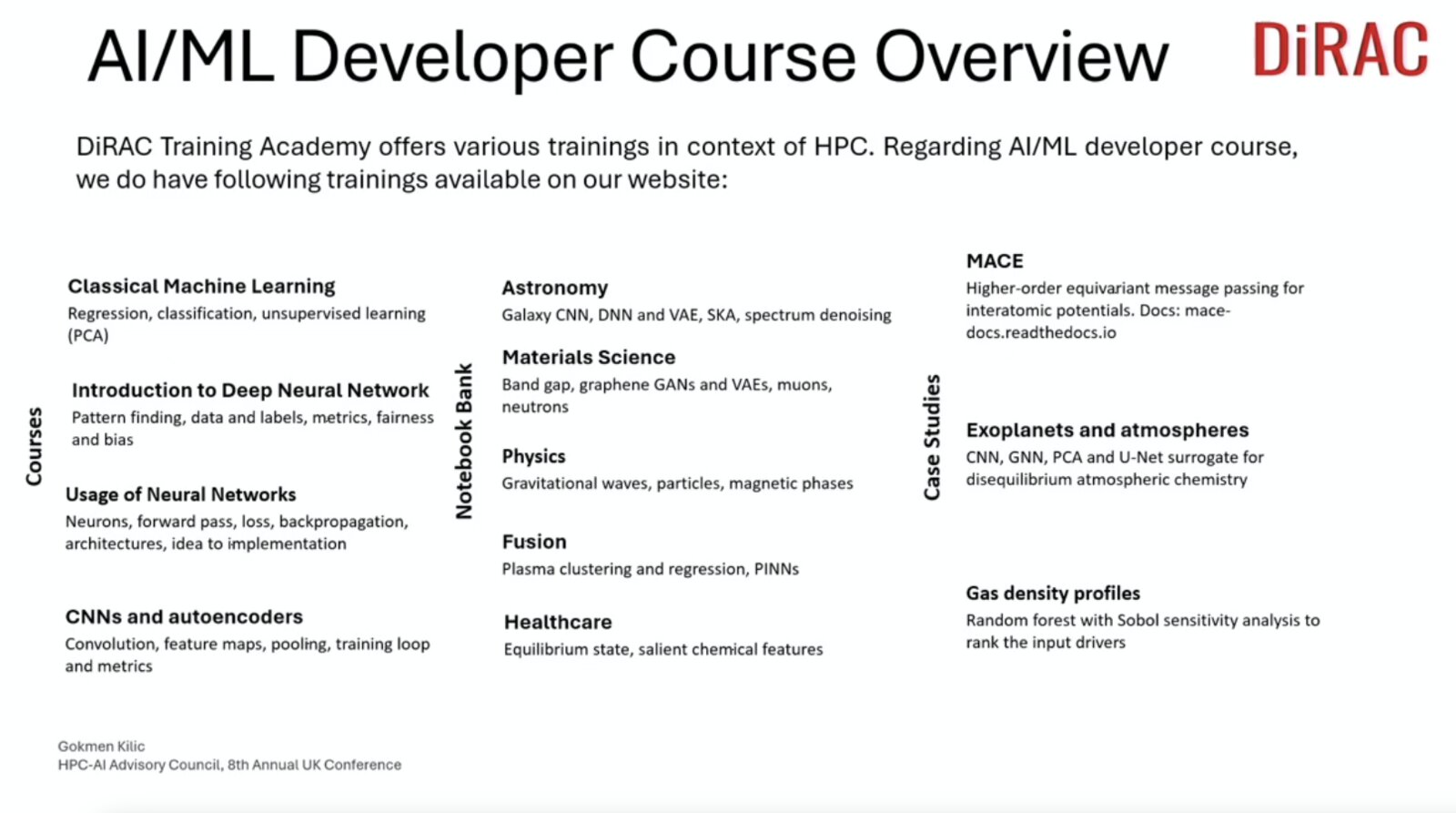
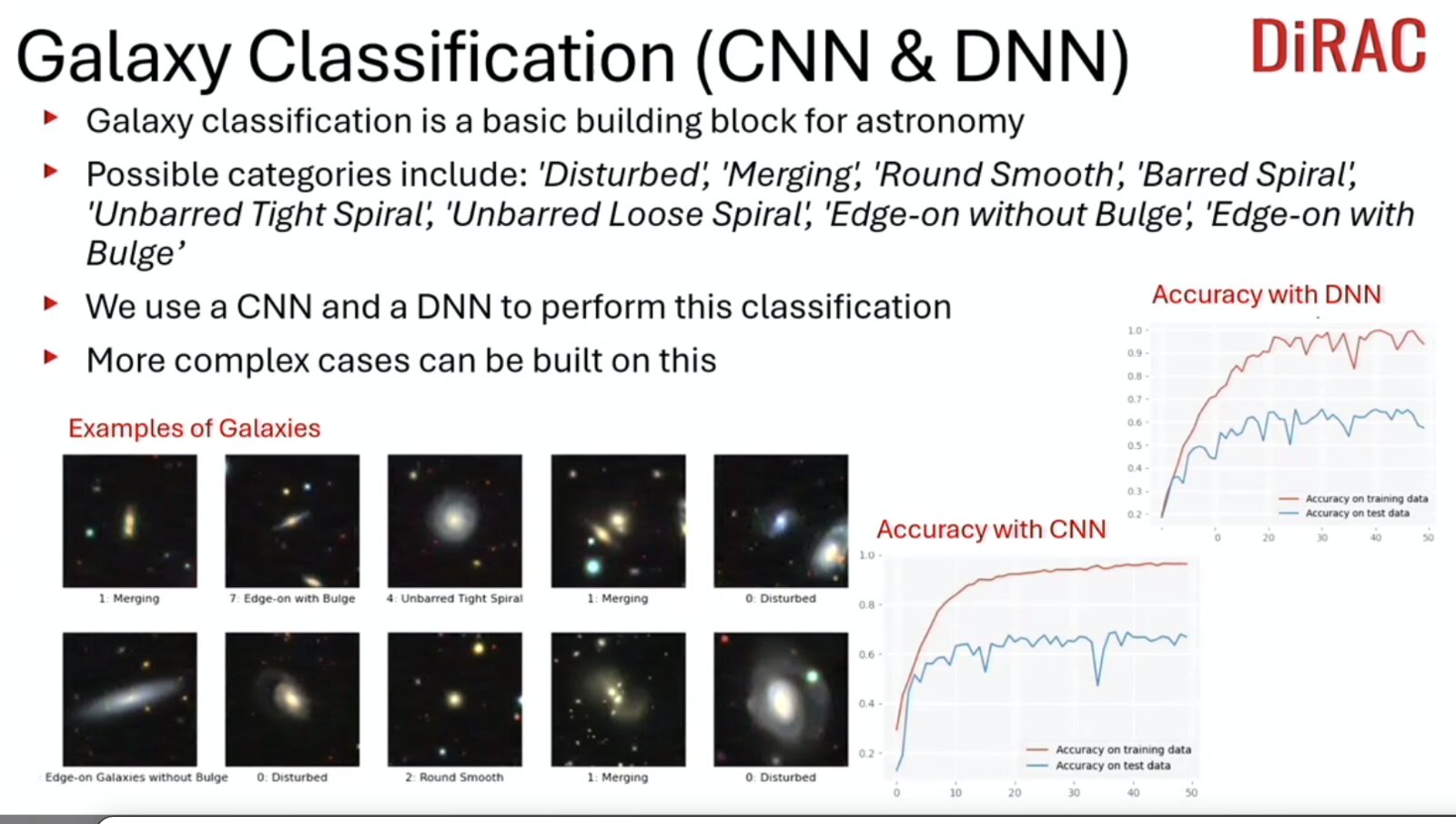
DiRAC Training Academy — Gökmen Kilic (Durham University)
A wide range of training. E.g.
13:00 Lunch
14:00 Research data and survival bias
Research Data and AI: Solving the Survival Bias of Publish or Perish — Penn Rainford (University of York)
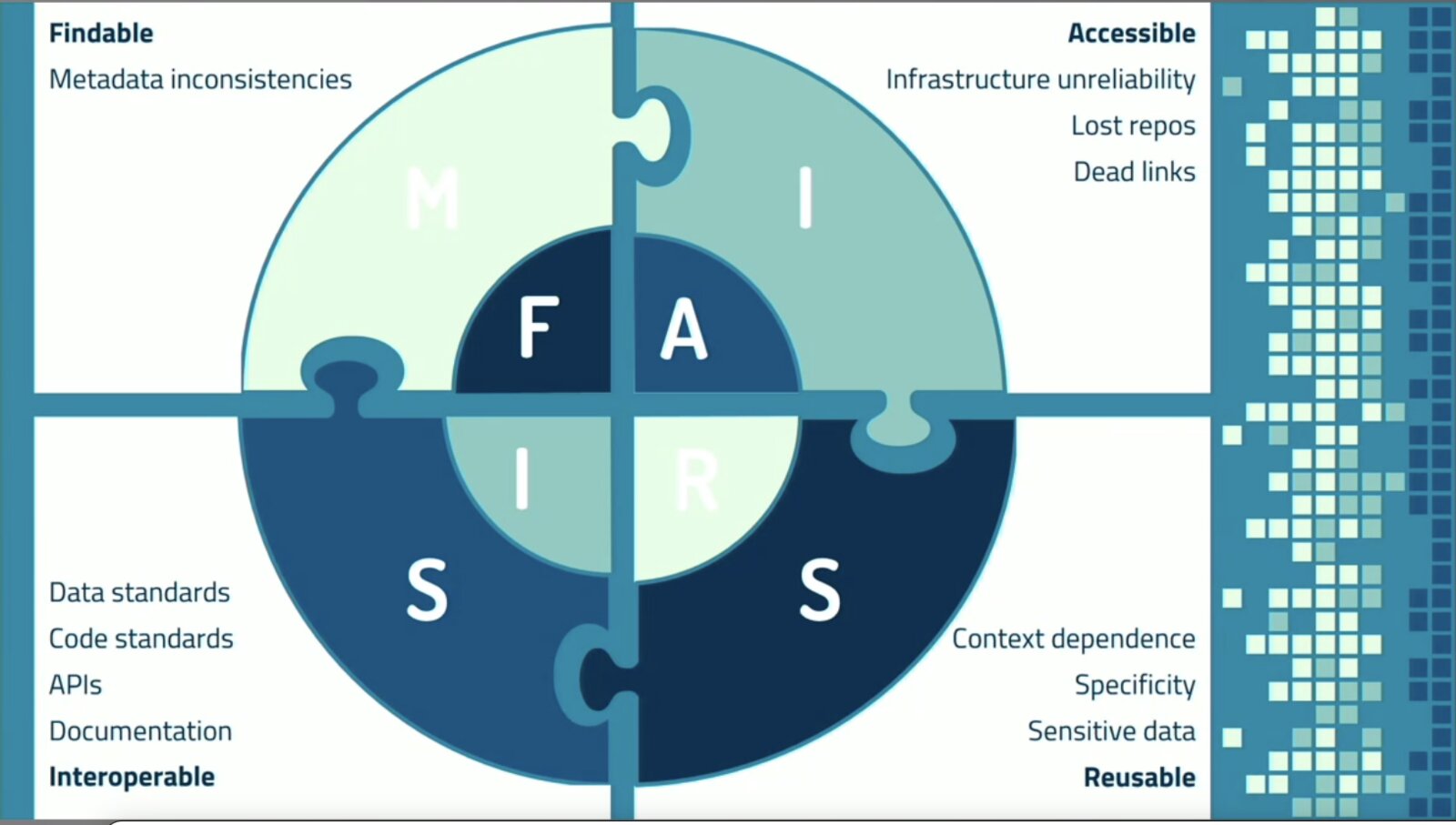
From keeping data, to questioning what to keep (2012), to FAIR.
We ask researchers to do everything (programming, etc.) in academia, even though it means they do it badly.
Publication bias: failures aren’t recorded, they stay in researchers’ heads, e.g. go up 1 degree and the bacteria die. So an AI doing research wouldn’t know this, because it is not in the data.
E.g.
- expected data
- unexplained data (can’t explain it → not a good publication → the data isn’t published)
- disagreeable data: can’t replicate it but not sure why (e.g. from environmental science), so it isn’t published
- unnecessary data
- outlier data
14:40 Compute and storage changes (sponsor)
Changes Across Both Compute and Storage in the HPC Eco System — Alex Putt (BIOS IT), Gordon Doherty (VDURA)
15:00 Zenith
Zenith - Sovereign Cloud Infrastructure for AI — Stig Telfer (StackHPC), Wojciech Turek (Cambridge University)
Someone in the audience pointed out that the CLOUD Act lets the US get at your data, which is a problem as they use Azure for the SRE.
Would we know if the CLOUD Act is invoked? If so, at least we’d know for sure when it happens, compared to someone secretly accessing your secure data. Not necessarily: a US warrant can come with a non-disclosure order under 18 U.S.C. § 2705(b), which stops the provider from telling the customer.
15:20 FRIDGE satellite TRE
Sensitive AI Workloads on National HPC Infrastructure: The FRIDGE Satellite TRE Model — Matt Craddock (Alan Turing Institute)
15:40 Coffee
16:00 Panel: sovereign & trustworthy AI
Panel: Sovereign & Trustworthy AI Infrastructure for the UK
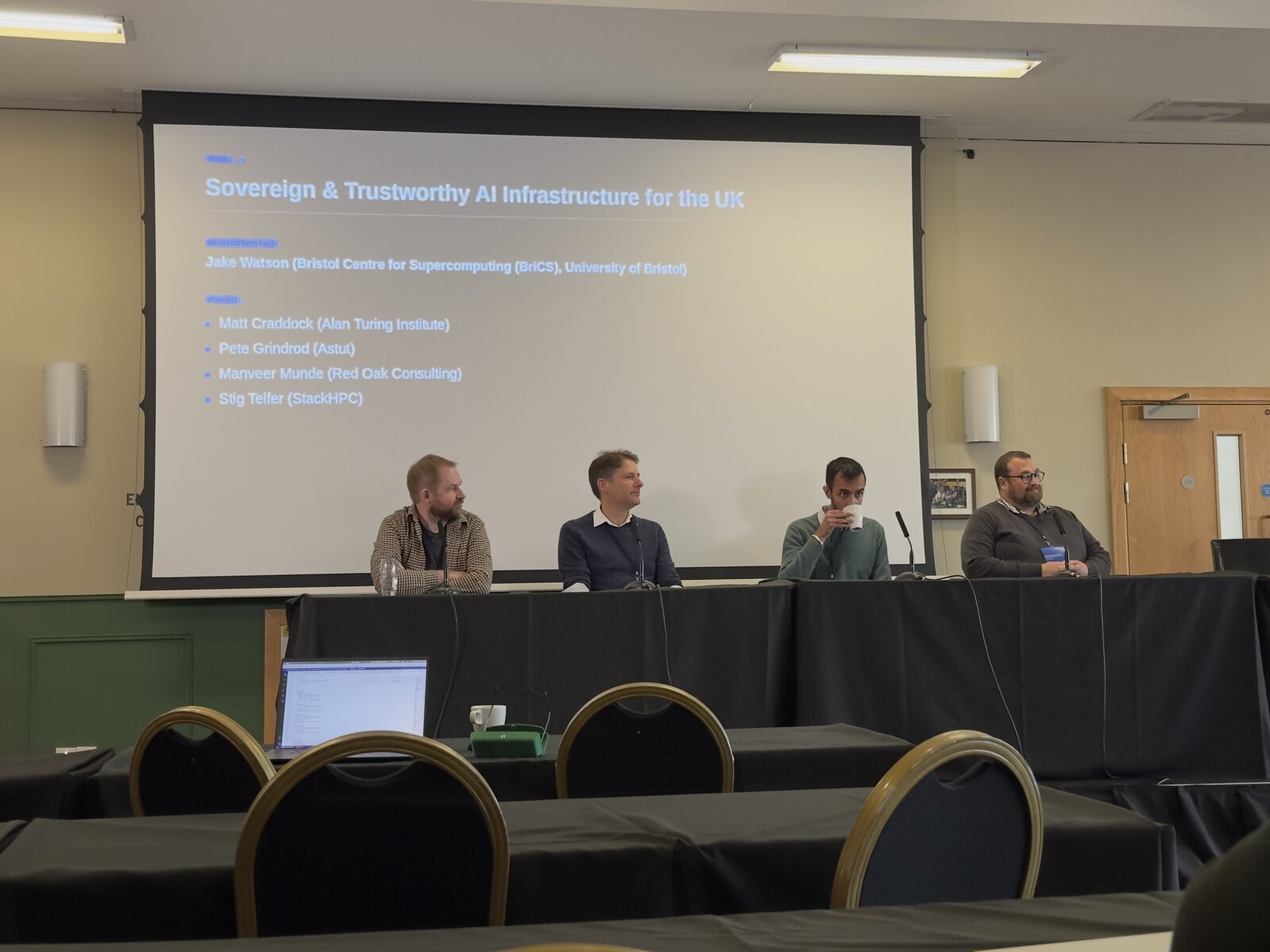
On the panel, with photos from their own profile pages:
- Jake Watson (moderator) — Bristol Centre for Supercomputing (BriCS), University of Bristol. He was one of the speakers of the Isambard-AI talk yesterday.
 Matt Craddock — Research Software Engineer at the Alan Turing Institute, working on the Data Safe Haven and FRIDGE. His talk at 15:20.
 Pete Grindrod — founder and CEO of Astut, an Oxford spin-out building Explorative AI for high-stakes decisions. He has served on the EPSRC and BBSRC Councils and the Ministry of Defence’s Defence Science Advisory Council. His talk at 10:05.
 Manveer Munde — Principal Consultant at Red Oak Consulting, with a background in computational condensed matter physics. His talk at 16:50.
 Stig Telfer — CTO of StackHPC. His talk at 15:00.
A historical parallel:
I’m always reminded of the story of how Britain developed its first atomic weapon. Which was, the Foreign Secretary went to a meeting in the US, and he came back, and he said, Prime Minister, I hope that no other Foreign Secretary of this country has spoken to the way I was spoken to by the US Secretary of State. We have to have an atomic weapon and it has to have a Union Jack on it. And I’m sort of reminded of that, thinking about right now, the bulk of compute sits in the US for training.1
One problem is AI escaping containers: in the last year it has been hard to keep up with the exploits, and it makes multi-tenancy a challenge.
16:30 Educational AI workloads
Trustworthy Compute Characteristics of Educational Artificial Intelligence Workloads: A Comparative Study of Large Language Models for National Assessment Systems — Louisa Muparuri (Zimbabwe Schools Examination Council)
16:50 Business case for research computing
Building the Business Case for Research Computing Investment — Manveer Munde (Red Oak Consulting)
17:10 Conference endnote
Conference Endnote: TBD — Andrew Davis (UKAEA)