What I found interesting at RSECon26

A short report back from the 10th Research Software Engineering Conference, Sheffield

Dr. Kolen Cheung, Research Software Engineer

Research Software & Analytics Group, University of Exeter

October 7th, 2026

AI at RSECon26

The two key themes of RSECon26: RSEs as part of the research journey, and enhancing credit & reproducibility. My impression is that AI was the central theme.

15 / 106

AI, ML or LLMs in the title

27 / 106

substantially about AI (my reading)

37 / 106

mention AI, ML or LLMs in the abstract

The 106 talks, posters, workshops and other contributions in the programme, keynotes included.

AI at RSECon26, by type

Type Total AI in title Substantially AI Mentions AI
Talk (incl. 3 keynotes) 54 8 13 19
Poster 24 3 5 6
Workshop 9 1 4 4
Birds of a Feather 8 1 2 5
Walkthrough 8 2 3 4
Research Software Publication 3 0 0 0
Total 106 15 27 37

RDSci Connect

  • A meetup for research data scientists, the day before the conference.
  • First RDSci meeting? A future RDSciCon!?
  • We discussed what activities we do, and how AI has impacted each of them.
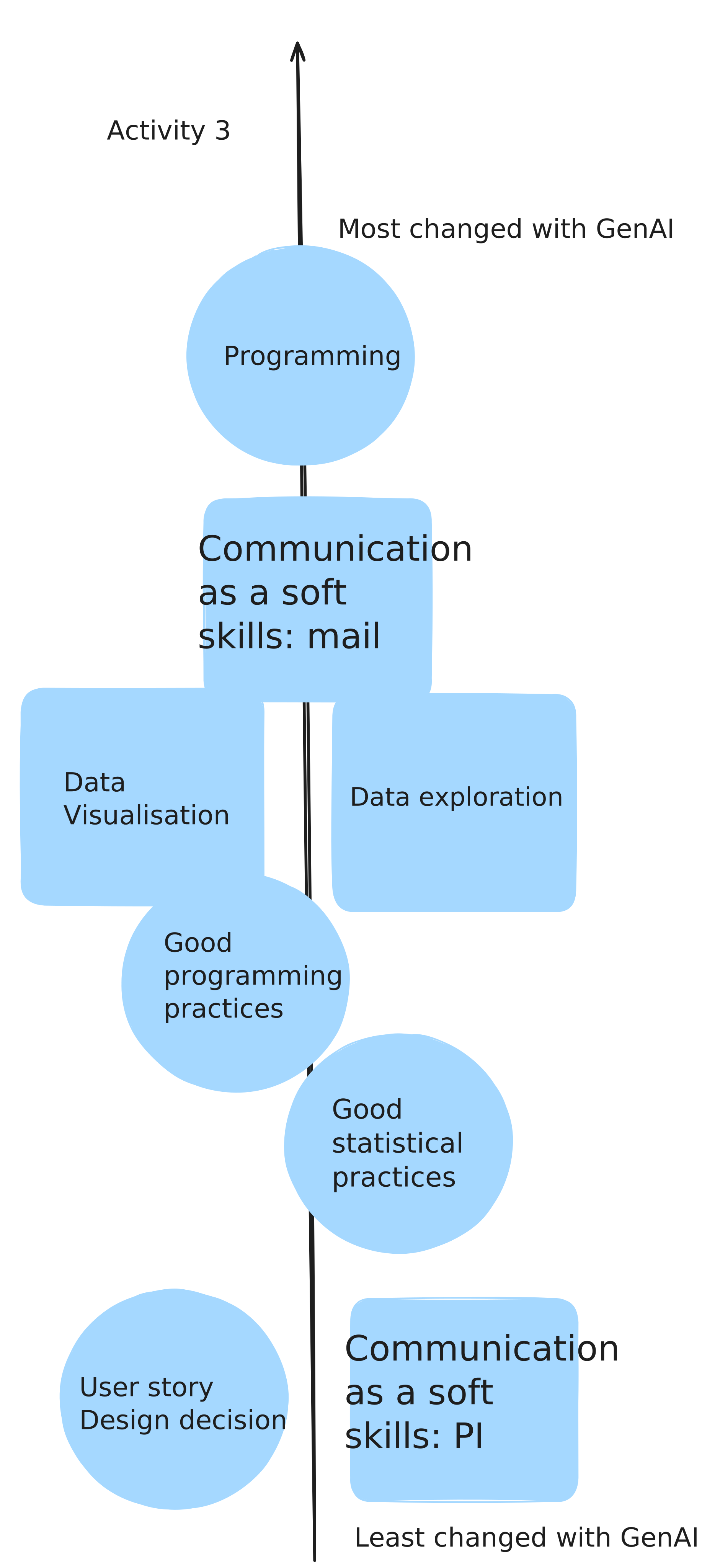
My group's board from RDSci Connect, Activity 3. A vertical axis runs from least changed with GenAI at the bottom to most changed at the top. Programming is at the top, then communication by email, then data visualisation and data exploration, then good programming practices and good statistical practices. User stories and design decisions, and communication with PIs, are at the bottom, least changed.

Where does the rigour go?

Arfon Smith’s keynote (2026), slides.

In many domains, faster science is a good thing. Unverified science is not.

What happens when the capacity to produce software grows much faster than the capacity to review and absorb it?

Much of science remains expensive to verify. Which parts of science we make cheaper to verify, and why, is a choice.

Evolving the RSE role in the age of AI

Druskat et al. (2026), slides.

The original value of RSEs: Bridging the worlds of research and software engineering

Producing code is cheap. Knowing if it is correct, appropriate, reproducible, worth sustaining is not.

The “GenAI-RSE paradox”: More generated code → more need for RSEs

An AI usage intensity spectrum

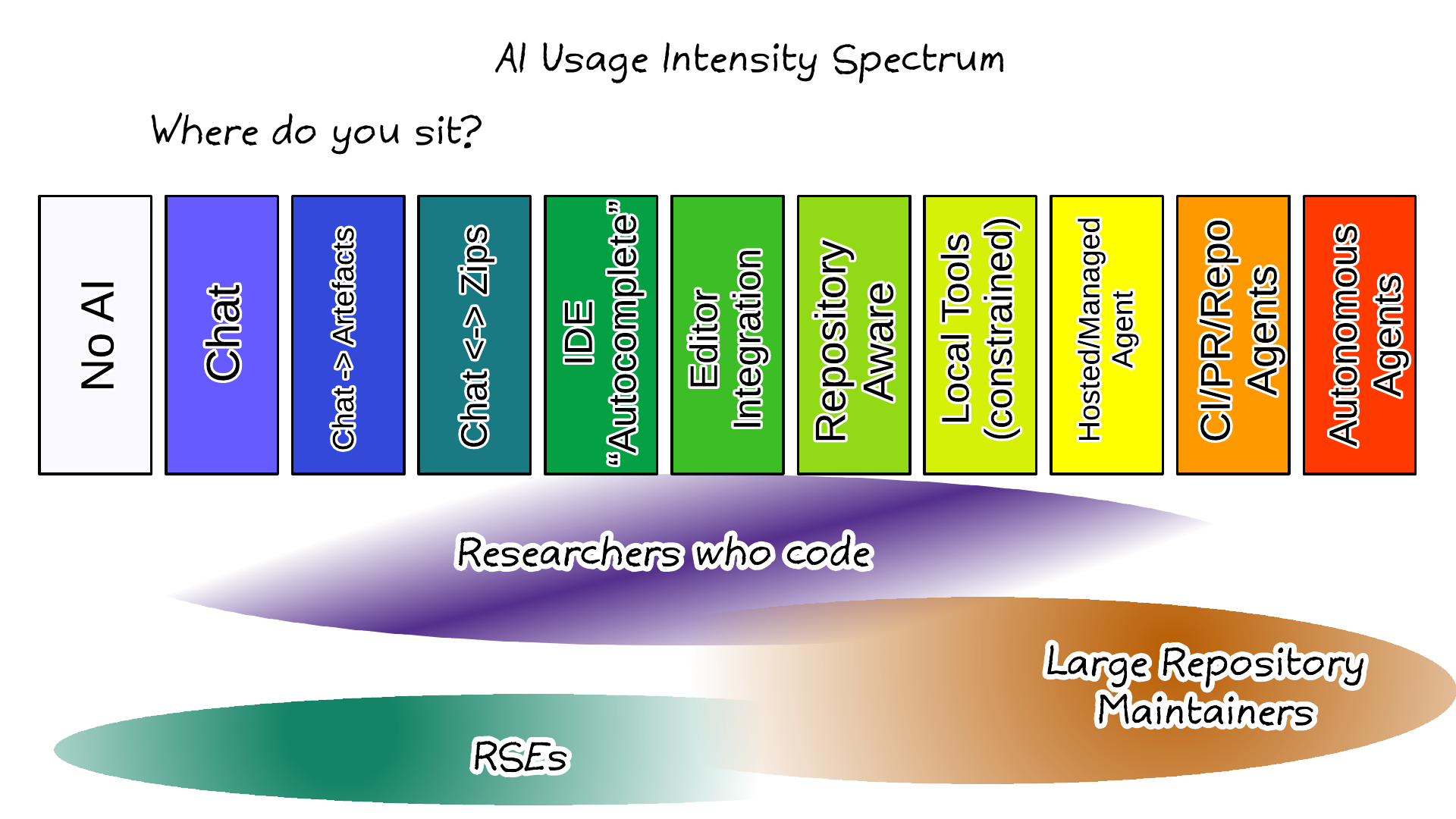
The AI Usage Intensity Spectrum from EVERSE RSQKit, asking "Where do you sit?". Eleven coloured columns run from No AI, through Chat, Chat to Artefacts, Chat with Zips, IDE autocomplete, Editor integration, Repository aware and Local tools (constrained), to Hosted/Managed agent, CI/PR/Repo agents and Autonomous agents. Below, three overlapping bands show where researchers who code, RSEs and large repository maintainers sit along it.

Sparks, Sufi and Nenadic (2026), slides, CC BY 4.0.

Code translation with LLMs

Thompson and Tamuri (2026), slides.

We will discuss our experiences in developing a Claude Code plugin to support domain experts in statistics in translating Stata packages to R and Python.

  • A demonstration of AI capability.
  • But is it a valid move to attach the original licence to machine-generated code?
  • Translating someone’s open source project with an LLM is contested. Were the original authors consulted?

Social infrastructure

April Johnson (2026), slides.

  • Engineering, science, education, learning, everything “depends on human connection”.
  • “That means our ‘soft’ skills are our most vital”.
  • Welcoming · listening · connecting · moving

Life in Hut 23

David Beavan (2026), slides: the Turing’s Research Engineering Group.

  • Interdisciplinary hub, pool of 30+ staff.
  • Open and collaborative
  • Regular team meetings, showcases and tech talks
  • Line management and mentorship
  • Hack week
  • Away day(s)
  • Newsletter
  • Pulse check

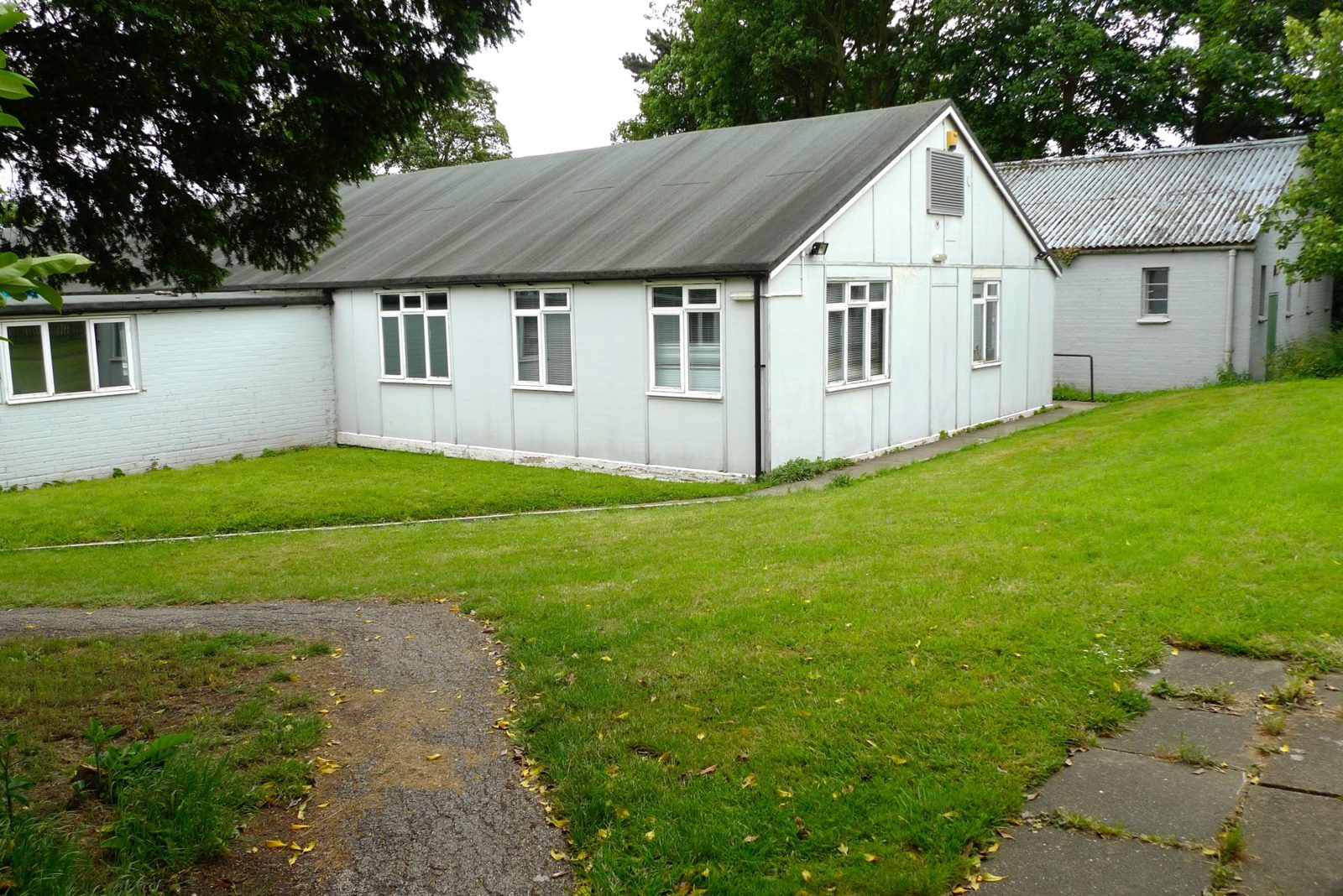
A single-storey white prefabricated hut with a grey pitched roof, on a lawn among trees.

Hut 23 at Bletchley Park, Bletchley Park’s engineering hut. Photo by John Keogh on Flickr, from the slides.

Multi-user LLM inference for research

Ryan Daniels (2026), slides.

  • Serving local LLMs with a custom-built system to university users and researchers at Cambridge.
  • For sovereignty, privacy and cost.
  • £120k + 3–5 people to develop and maintain the system (his answer to my question).